
What is the difference between Leeb hardness tester and ultrasonic hardness tester?
Keywords: Leeb hardness tester, ultrasonic hardness tester, UCI
Introduction:
Hardness testing is an essential process in various industries to determine the resistance of a material against permanent deformation. There are different methods available for hardness testing, including Leeb hardness testing and ultrasonic hardness testing. In this article, we will explore the differences between these two techniques and discuss their unique features.
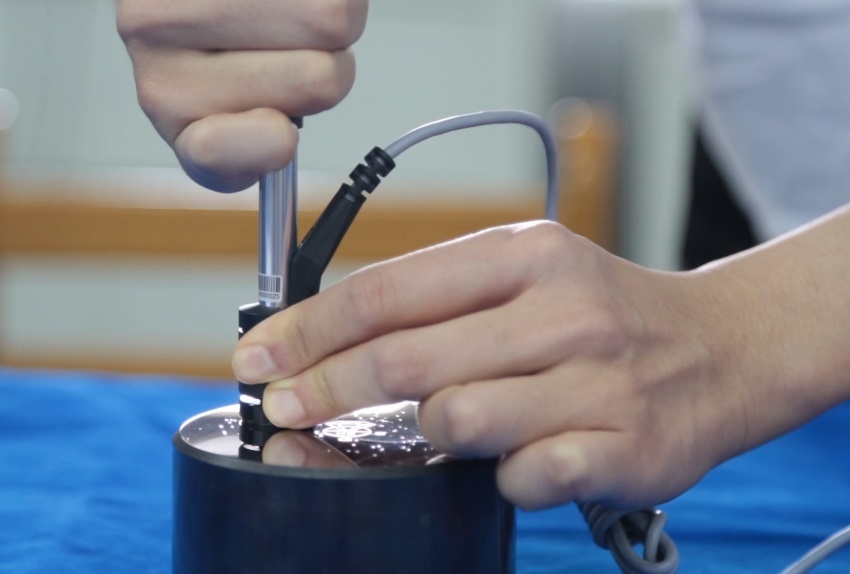
Leeb hardness tester:
The Leeb hardness tester is a portable device that measures the hardness of a material by measuring the rebound velocity of a test probe. It utilizes the Leeb rebound method, where a small impact body is propelled against the material surface, and the rebound velocity is measured. This velocity is then converted into a hardness value using an algorithm.
Advantages of Leeb hardness tester:
1. Portability: Leeb hardness testers are lightweight and handheld, making them suitable for on-site hardness testing.
2. Wide range of applications: Leeb hardness testers can be used on various materials, including metals, alloys, and even plastics.
3. Quick and easy operation: These testers provide instant hardness values, allowing for efficient testing and analysis.
4. Non-destructive testing: Leeb hardness testing does not cause any damage to the material being tested.
Limitations of Leeb hardness tester:
1. Surface roughness sensitivity: The accuracy of Leeb hardness testers can be affected by the surface roughness of the material. Smoother surfaces yield more accurate results.
2. Limited measurement depth: The Leeb method is suitable for measuring surface hardness, but it may not provide accurate results for measuring the hardness of thin coatings or subsurface layers.
Ultrasonic hardness tester:
Ultrasonic hardness testers use the principle of sound wave propagation to measure the hardness of a material. These testers generate ultrasonic waves that are transmitted into the material, and the hardness value is determined based on the time taken for the sound waves to travel through the material.
Advantages of ultrasonic hardness tester:
1. Accurate measurements: Ultrasonic hardness testers provide precise hardness values and are less affected by surface roughness.
2. Measurement depth control: These testers can measure the hardness of thin coatings and subsurface layers accurately.
3. Versatility: Ultrasonic hardness testers can be used on a wide range of materials, including metals, alloys, ceramics, and composites.
Limitations of ultrasonic hardness tester:
1. Equipment complexity: Ultrasonic hardness testers are more complex and require specialized training for operation.
2. Cost: Compared to Leeb hardness testers, ultrasonic hardness testers are generally more expensive.
3. Time-consuming: Ultrasonic hardness testing may take longer to obtain results compared to Leeb hardness testing.
UCI (Ultrasonic Contact Impedance) method:
UCI is a specific method used with ultrasonic hardness testers. It involves a Vickers diamond indenter that is pressed against the material surface, creating an ultrasonic resonance. The hardness value is determined based on the frequency shift caused by the indentation.

Conclusion:
Both Leeb hardness testers and ultrasonic hardness testers have their own advantages and limitations. Leeb hardness testers are portable, easy to use, and suitable for surface hardness testing. On the other hand, ultrasonic hardness testers provide accurate measurements for various materials and can measure thin coatings and subsurface layers. The UCI method, used with ultrasonic hardness testers, offers a specific approach for hardness testing. The choice between these two methods depends on the specific requirements of the application and the type of material being tested.
-
Phone: +86-10-62966798
Fax: +86-10-62980728
Email: export@timegroupndt.com.cn